


Earth has a second moon: NASA confirms 2025 PN7 will co-orbit until 2083
NASA has confirmed that Earth has a second moon, 2025 PN7, a small asteroid co-orbiting with our planet until 2083.
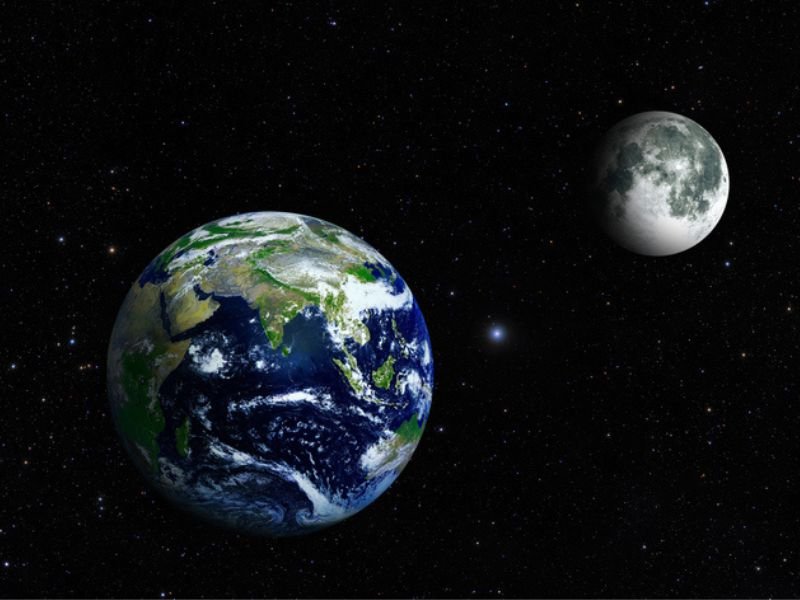
In August 2025, astronomers discovered a small asteroid named 2025 PN7, which has been identified as a quasi-satellite of Earth. Unlike the Moon, which is gravitationally bound to our planet, 2025 PN7 shares an orbit around the Sun that closely mirrors Earth's path. This unique orbital relationship gives the appearance of a second moon from certain vantage points on Earth.
ALSO READ: The fiery Blood Moon: Views from KZN
How does 2025 PN7 orbit?
2025 PN7 does not orbit Earth directly. Instead, it follows a solar orbit in a 1:1 resonance with Earth, meaning it completes one orbit around the Sun in the same time it takes Earth to do so.
This alignment causes it to appear to follow Earth through space, creating the illusion of a second moon, reports Times of India. Its orbit is not perfectly circular; it varies in distance from Earth, ranging from approximately 4 million to 17 million kilometres.
How long will 2025 PN7 remain in this orbit?
Calculations suggest that 2025 PN7 has been in its current orbit for about 60 years and is expected to remain a quasi-satellite of Earth for approximately 128 years. After this period, gravitational interactions with the Sun and other celestial bodies are likely to alter its trajectory, causing it to transition into a different orbital pattern, such as a horseshoe orbit.
2025 PN7 is a relatively small asteroid, measuring between 18 and 36 metres in diameter. This size is comparable to a small building. Despite its proximity to Earth, its small size and low reflectivity make it extremely faint, with an apparent magnitude of around 26. As a result, it is not visible to the naked eye and can only be detected with powerful telescopes.
Is 2025 PN7 a threat to Earth?
No, 2025 PN7 poses no threat to Earth. Its orbit is stable, and it does not come close enough to our planet to cause any concern. The asteroid's small size and the vastness of space further reduce any potential risk. Instead, its presence offers a unique opportunity for scientific study.
The discovery of 2025 PN7 provides valuable insights into the dynamics of near-Earth objects and their interactions with our planet. As a quasi-satellite, it offers a natural laboratory for studying orbital mechanics, the behaviour of small bodies in the solar system, and the processes that govern their movements. Understanding such objects can enhance our knowledge of the solar system's formation and evolution.
How was 2025 PN7 discovered?
2025 PN7 was first observed on August 2, 2025, by the Pan-STARRS1 telescope at the Haleakalā Observatory in Hawaii. Archival data indicates that it has been orbiting near Earth for decades, possibly since the 1960s. Its faintness and small size contributed to its initial undetected status, highlighting the importance of advanced astronomical surveys in identifying such objects.
Can 2025 PN7 be seen from Earth?
Due to its small size and low reflectivity, 2025 PN7 is extremely faint and cannot be seen with the naked eye or typical amateur telescopes. Its detection requires the use of powerful observatories equipped with advanced imaging technology. Even then, observations are limited to specific times when the asteroid is favourably positioned relative to Earth.
After approximately 128 years in its current orbit, 2025 PN7 is expected to transition into a different orbital pattern, such as a horseshoe orbit, due to gravitational influences from the Sun and other celestial bodies.
ALSO READ: There’s a new GPS for the moon

HOW TO LISTEN TO EAST COAST RADIO
1. Listen to East Coast Radio on the FM (frequency modulation) spectrum between 94 and 95 FM on your radio.
2. Listen live to ECR by clicking here or download the ECR App (iOS/Android).
3. Listen to East Coast Radio on the DStv audio bouquet, channel 836.
4. Switch to the audio bouquet on your Openview decoder and browse to channel 606.
5. Listen to us on Amazon Alexa.
Follow us on social media:
Image courtesy of iStock. Information courtesy of NASA and Times of India.
Have a similar story or something unique to share? Email us at [email protected], we would love to hear from you!