


US, Russian astronauts return to Earth after year in space
US astronaut Scott Kelly and Russian cosmonaut Mikhail Kornienko have returned to Earth after spending almost a year in space in a ground-breaking experiment foreshadowing a potential manned mission to Mars.
The 340-day mission saw Kelly claim the record for the longest single stay in space by a US astronaut, while Kornienko is now fifth on the list for lengthiest mission by a Russian cosmonaut.
"We have landing," Russian Mission Control confirmed after the trio touched down southeast of the settlement of Dzhezkazgan in central Kazakhstan at around 0430 GMT.
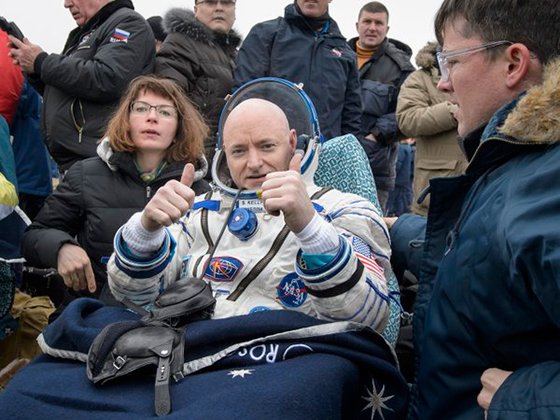
After returning from his lengthy stint in space Kelly was clearly in high spirits as he was lowered to the ground by burly Russian rescue workers at the landing site.
Crew returns to Earth after a historic #YearInSpace mission. Details: https://t.co/yxd2XYDaji pic.twitter.com/eqSt0yzbfM
— Intl. Space Station (@Space_Station) March 2, 2016
Two thumbs up from @StationCDRKelly after landing from his #YearInSpace. More photos here: https://t.co/HTfkGxYy75 pic.twitter.com/Z5gre1la0G
— NASA (@NASA) March 2, 2016
"The air out here feels great. I've no idea why you guys are so bundled up," NASA TV reported him as saying as he sat upright in a chair on the steppe in temperatures just below zero degrees Celsius (32 degrees Fahrenheit).
Kelly and Kornienko returned with Russia's Sergei Volkov, who was stationed at the ISS for over five months and was met upon landing by his father, retired cosmonaut Aleksandr Volkov.
The "one-year crew" mission -- which began on March 27 last year -- was the longest by any astronauts aboard the ISS and seen as a vital chance to measure the effects of a prolonged period in space on the human body.
Welcome home @StationCDRKelly! Your #YearInSpace helps ensure humans are “go” for our #JourneyToMarshttps://t.co/5TkCH23Hwy
— NASA (@NASA) March 2, 2016
New views of the reentry of the #YearInSpace crew earlier returning to Earth from @Space_Station: https://t.co/96LV6YYR3r
— NASA (@NASA) March 2, 2016
'Giant leap to boots on Mars'
"Scott Kelly's one-year mission aboard the International Space Station has helped to advance deep space exploration and America's Journey to Mars," NASA administrator Charles Bolden in a statement.
"Scott has become the first American astronaut to spend a year in space, and in so doing, helped us take one giant leap toward putting boots on Mars."
The pair were subjected to a battery of tests before and after their ascent towards the ISS and underwent more tests soon after landing.
Weightlessness reduces muscle mass and bone density and is believed to diminish eyesight by increasing cerebrospinal fluid around the optic nerve.
Kelly, 52, was also part of an experiment comparing his development and changes in space with his identical twin brother - Mark - back on Earth.
He will now arrive by chartered flight in Houston for a NASA medical examination.
After 340 days in space, @StationCDRKelly is back on Earth from his #YearInSpace mission. https://t.co/KX5g7yYnYG https://t.co/dhCfP1M6tZ
— NASA (@NASA) March 2, 2016
Recovery teams are in position around @StationCDRKelly's landing zone as he returns from a #YearInSpace pic.twitter.com/RCjtK9DVpJ
— NASA (@NASA) March 2, 2016
Gorilla in space
In his year aboard the space station Kelly has been an avid Internet poster, capturing stunning views on his Instagram page and tweeting regularly to nearly a million followers while travelling some 143 million miles (230 million kilometres).
In one particularly eye-catching stunt, the bald-headed astronaut posted a short video of himself dressed up in a gorilla suit and floating through the ISS in pursuit of a colleague.
"Needed a little humour to lighten up a year in space," he wrote on Twitter on February 23, when he posted the video.
One image Kelly tweeted captured the economic divide between North and South Korea as visible from space, with the South aglow with electric lights and the North cast in a blanket of darkness.
Another impressive shot was one of the Milky Way which Kelly described as "old, dusty, gassy and warped. But beautiful."
"Spaceflight is the biggest team sport there is, and it's incredibly important that we all work together to make what is seemingly impossible possible," Kelly said when handing over command of the ISS to fellow NASA astronaut Tim Kopra on Monday.
#Countdown #Throwback That one day about a year ago. Huge thanks to all who joined me on this journey! #YearInSpace pic.twitter.com/eztxUT0OQz
— Scott Kelly (@StationCDRKelly) February 26, 2016
Of all the sunrises I've seen on my #YearInSpace, this was one of the best! One of the last too. Headed home soon. pic.twitter.com/AD4YEiN5kR
— Scott Kelly (@StationCDRKelly) February 27, 2016
Likely my last pic of the #moon from space. Reminded me of my friend, #GeneCernan the @lastmanonmoon! #YearInSpace pic.twitter.com/4YCHj6s5E9
— Scott Kelly (@StationCDRKelly) February 28, 2016
The ISS trio leave behind Kopra, Russian cosmonaut Yuri Malenchenko and the European Space Agency's British astronaut Tim Peake.
NASA's Jeff Williams and Roscosmos' Oleg Skriprochka and Alexey Ovchinin, will join them following a launch from Baikonur later this month.
The record Kelly beat for consecutive days spent in space by an American astronaut was previously held by Michael Lopez-Alegría, who spent 215 straight days in space in 2007.
The world record for longest single stay in space is held by Russian Valery Polyakov, who spent some 438 days on the Mir space station from 1994 to 1995.
The ISS space laboratory has been orbiting Earth at about 28,000 kilometres (17,000 miles) an hour since 1998.
Space travel has been one of the few areas of international cooperation between Russia and the West that has not been wrecked by the Ukraine crisis.
#Countdown #Throwback Milky Way #YearInSpace pic.twitter.com/Tl5ceU34HY
— Scott Kelly (@StationCDRKelly) February 29, 2016
#Countdown We're down to a wakeup. #Earth. I'm coming for you tomorrow! #GoodNight from @space_station! #YearInSpace pic.twitter.com/kLe2755XyG
— Scott Kelly (@StationCDRKelly) March 1, 2016
#Thanks for following our #YearInSpace The journey isn't over. Follow me as I rediscover #Earth! See you down below! pic.twitter.com/7byNy6fMG4
— Scott Kelly (@StationCDRKelly) March 1, 2016