


SA cuts growth forecast to 1.4% amid global uncertainty
South Africa's economy is forecast to now grow at 1.4 per cent in 2025, slashed from the 1.9 per cent projected just two months ago.
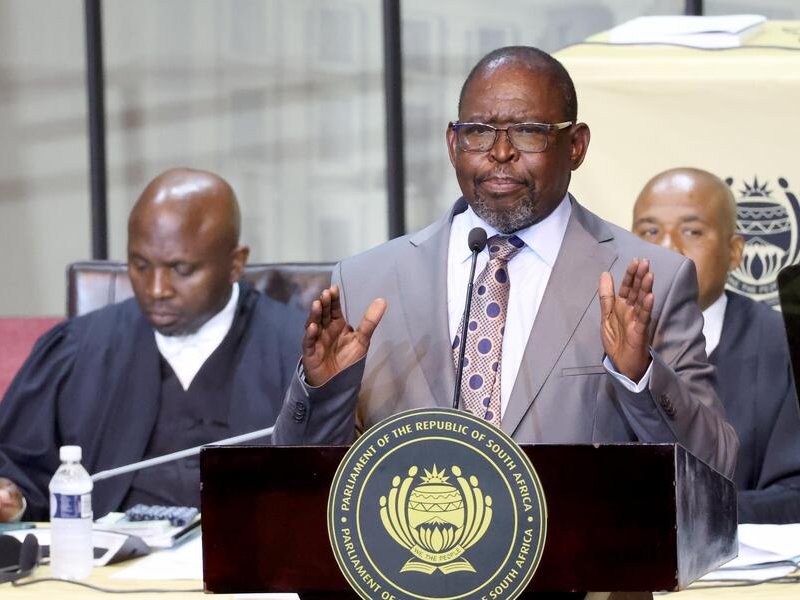
Finance Minister Enoch Godogwana tabled his budget on Wednesday afternoon, his third attempt.
He says the global economic outlook doesn't look promising amid heightened trade tensions and elevated policy uncertainty.
"Over the next two years, we project real GDP growth to rise moderately to 1.6 per cent in 2026 and 1.8 per cent in 2027. Looking further ahead, the risks to the outlook remain elevated. These include the worsening global outlook, weaker-than-expected growth in the fourth quarter of 2024, the persistence of logistics constraints and higher borrowing costs."
Godogwana says the global economic outlook puts South Africa in a vulnerable position.
He says the budget aims to promote growth and shield our country from the worst impacts of an increasingly uncertain global environment.
"The International Monetary Fund now projects global growth at 2.8 per cent in 2025. This is 0.5 percentage points lower than the January estimate. Similarly, global trade is projected at 1.7 per cent in 2025, which is also much lower than the January estimate. At the same time, inflation expectations are now above central bank targets in many advanced and emerging market economies. And new trade barriers may raise inflation and prolong the cycle of higher interest rates."
Godongwana has announced a revised fiscal strategy aimed at curbing government debt.
"In 2025/26, government debt is projected to stabilize at 77.4 per cent of GDP. While this is 1.2 per cent higher than projected in the March 12 budget, it is mainly due to lower nominal GDP. The main budget deficit decreases by R8 billion over the MTEF, compared to our estimates in March. This narrower deficit is enabled by the steadily expanding primary surplus."
Primary surplus will grow from an estimated 0.8% of the GDP in this financial year to 2.1%.
"A growing primary surplus means that our revenue will continue to be larger than our non-interest expenditure over the next three years. This contributes to lowering our gross borrowing requirements, resulting in lower debt and lower debt service costs over time.
"However, debt service costs remain high, amounting to more than R1.3 trillion over the next three years. Put differently, this means in 2025/26 alone we are spending around R1.2 billion per day to service our debt."
Find us on social media
Follow the ECR Newswatch WhatsApp channel here
We are also on Facebook and X (formerly Twitter)
