


Mashatile hails Lenacapavir potential as SA ramps up fight against HIV
Deputy President Paul Mashatile has warned that South Africa cannot afford to repeat the mistakes made during the early antiretroviral era, which was marked by delays and missed opportunities.
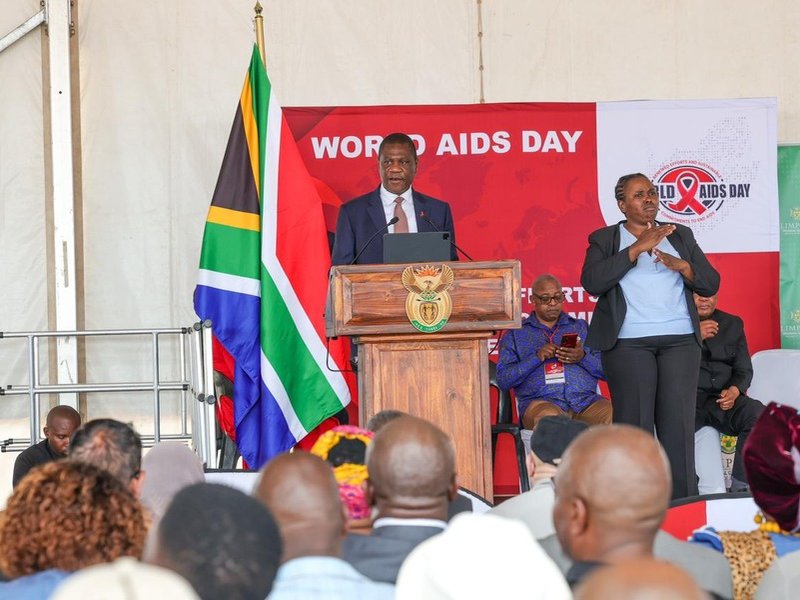
Speaking in his capacity as the chairperson of the South African National AIDS Council, Mashatile urged the country to act with urgency, foresight, and unity in the battle against the disease.
ALSO READ: Boil alert confined to Athlone Park as eThekwini probes reservoir issue
Mashatile’s address at the World Aids Day commemoration in Limpopo came on the back of the news that South Africa will begin administering a groundbreaking new HIV-prevention injection in the drug's first public rollouts in Africa.
Lenacapavir, taken twice a year, has been shown to reduce the risk of HIV transmission by more than 99.9 per cent, making it functionally akin to a potent vaccine.
In South Africa, where one in five adults lives with HIV, a Wits University research unit oversaw the rollout as part of an initiative funded by Unitaid, the United Nations health agency.
Mashatile described Lenacapavir as not merely a scientific breakthrough, but “a symbol of what becomes possible when science, political will, and community demand meet at the same table”.
He noted that the drug holds profound promise for young women and girls who often cannot negotiate condom use.
“It empowers adolescent girls navigating relationships marked by power imbalances. It provides protection for key populations who face stigma and discrimination. It supports workers and learners who struggle with the burden of daily pill adherence,” Mashatile said.
Despite South Africa surpassing the first and third UNAIDS 95-95-95 targets, challenges remain in ensuring that people who are diagnosed begin and stay on treatment.
The UNAIDS 95-95-95 target aims for 95% of people living with HIV to know their status, 95% of those diagnosed to be on sustained antiretroviral therapy, and 95% of those on ART to have a suppressed viral load.
The country's current progress stands at 96-80-97, compared to global figures of 95-85-92.
To address the treatment–initiation gap, Mashatile highlighted the national recovery initiative launched on 25 February 2025—the 1.1 million “Close the Gap” Treatment Acceleration Campaign.
“To close the 1.1 million gap and prepare for long-acting prevention, we must critically examine our efforts towards marginalised communities and our willingness to embrace new scientific advancements,” he said.
Mashatile also welcomed the rollout of the Six-Month Multi-Month Dispensing model, introduced by Health Minister Aaron Motsoaledi.
This model allows stable patients to collect a six-month supply of ARVs in a single visit, reducing travel costs, decongesting clinics, and improving treatment adherence.
“The results will improve treatment adherence and patient outcomes, contributing to achieving the second 95 target,” Mashatile added.
Find us on social media
Follow the ECR Newswatch WhatsApp channel here
We are also on Facebook and X (formerly Twitter)
