


Apartheid regime feared Luthuli’s influence, says Radebe
Convenor of the ANC in KwaZulu-Natal Jeff Radebe says Chief Albert Luthuli was seen as a major threat by the apartheid regime, not because he broke the law, but because he kept finding ways around it.
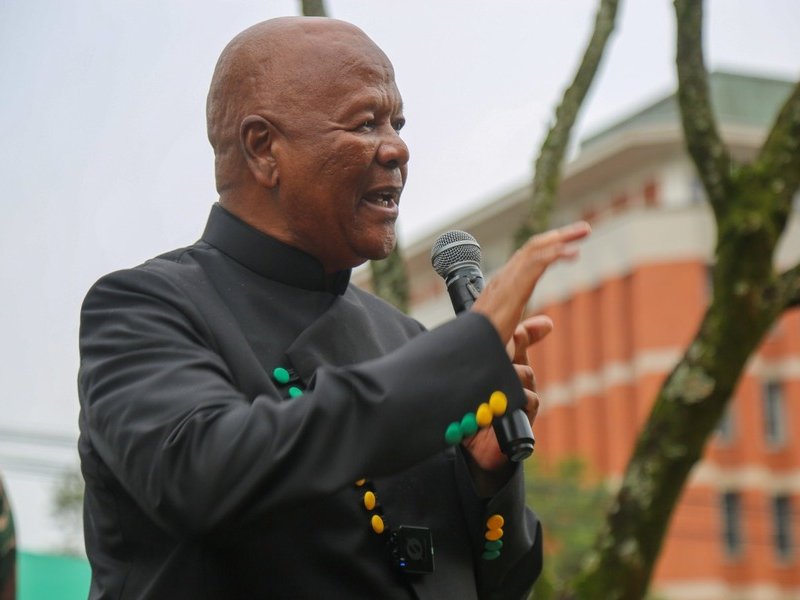
On Tuesday, Radebe was testifying at the inquest into Luthuli’s death, currently underway at the Pietermaritzburg High Court.
The anti-apartheid icon and Nobel Peace Prize winner died in 1967, allegedly after being struck by a train in Groutville, north of Durban. But his family and the African National Congress (ANC) have long suspected foul play.
The inquest is expected to explore whether his death was politically motivated, a targeted assassination masked as an accident.
Radebe believes the apartheid government was threatened by Luthuli’s leadership, popularity, and international recognition.
He added that Luthuli's ability to continue political work despite severe state repression made him a formidable opponent.
"The dynamic and effective leadership of Chief Luthuli changed the ANC forever,” Radebe told the court.
"From a conservative organisation in 1912, to a radical movement that launched the Defiance Campaign in 1952, and later embarked on the armed struggle in 1961, Chief Luthuli was at the centre of that transformation.
"His influence crossed racial lines. He was internationally respected, especially after being awarded the Nobel Peace Prize.
With the armed struggle in Zimbabwe looming, the apartheid regime likely saw his continued leadership as intolerable.”
Radebe cited recently surfaced correspondence between apartheid security operatives as further proof of how seriously the state viewed Luthuli.
"That letter shows the Special Branch considered him a serious threat. Despite numerous banning orders, he outwitted them. holding secret meetings with ANC leadership and discussing highly sensitive matters.
Even after the ANC was banned in 1961, he remained active in the liberation effort.”
Radebe, a trained lawyer, also criticised the judiciary under apartheid, describing it as an instrument of the oppressive state.
"The judiciary wasn’t independent, it was part of the machinery of subjugation. The 1967 inquest that ruled Luthuli’s death an accident cannot be trusted,” he said.
He referred to a letter written by the magistrate who oversaw the original inquest, addressed to the Secretary of Justice, as proof that due process was compromised.
"A presiding officer communicating directly with the executive violates the doctrine of separation of powers.
That magistrate prejudged the matter, undermining the rule of law.
There was no separation between the bench and the state, magistrates acted as an extension of the apartheid regime.”
Radebe also placed Luthuli’s death in a broader pattern of political assassinations of liberation leaders across the continent.
"A week before Oliver Tambo and James Chikerema of ZAPU issued the military command ‘To war, comrades’, President Luthuli was killed in Groutville.
The apartheid state covered up the assassination as a train accident. No one in the ANC or the global liberation movement believed that story.
It was a cold-blooded killing, the beginning of a pattern. Eduardo Mondlane of FRELIMO was assassinated in 1969. Amilcar Cabral of Guinea-Bissau followed in 1973.”
The inquest proceedings continue on Wednesday.
